


June 2025
Last week HB 335 was introduced which included a host of property tax proposals and amounts to the most comprehensive changes to Ohio’s property tax system in nearly 50 years. While many of the property tax changes have been introduced in other legislation, one proposal that was not is the idea to repeal the 10 unvoted property tax mills often referred to as “inside millage”. Because the 10-mills of inside millage are specifically articulated in the state Constitution, many long-time observers of state and local finance in Ohio have long considered this to be beyond the reach of legislative change. However, the architects of HB 335 have asserted that the Constitution places a 10-mill maximum on inside millage rather than creating a requirement for 10 mills of inside millage. Inside milage is currently allocated to school districts, counties, municipalities, townships and various special district providing specific public services. Under HB 335, only townships would retain their inside millage.
The Ohio Legislative Service Commission (LSC) has released a preliminary analysis of the impact of the repeal of inside millage on the various types of local government in Ohio. This report summarizes the data in the LSC spreadsheet and provides additional analysis of the impact school districts conducted by OEPI.
LSC Analysis of Impact of Repealing Inside Millage
Table 1 provides a summary of LSC’s tabulation of the taxes generated by inside millage across different types of local government jurisdictions in Ohio.
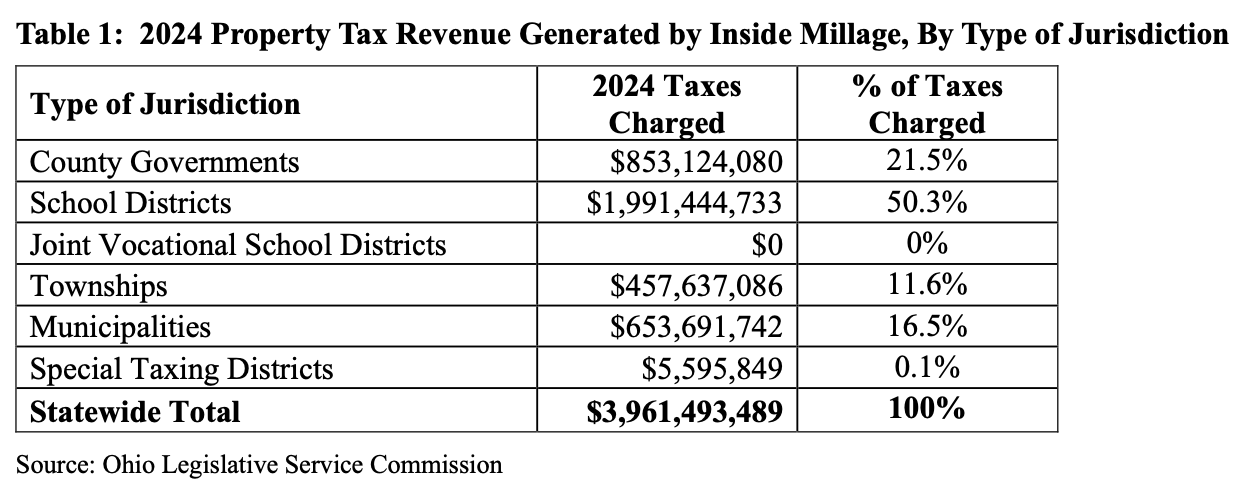
Table 1 shows that almost exactly half of property taxes from inside millage are collected by Ohio’s traditional K-12 school districts, while 21.5% are collected by county governmental units (presumably not just counties but also countywide agencies such as Developmental Disability Boards, Alcohol Drug Addiction and Mental Health Boards, as well as Departments of Health, Aging, Children’s Services and other similar service providers). Additionally, municipalities are responsible for 16.5% of inside millage tax collections and townships are responsible for 11.6%.
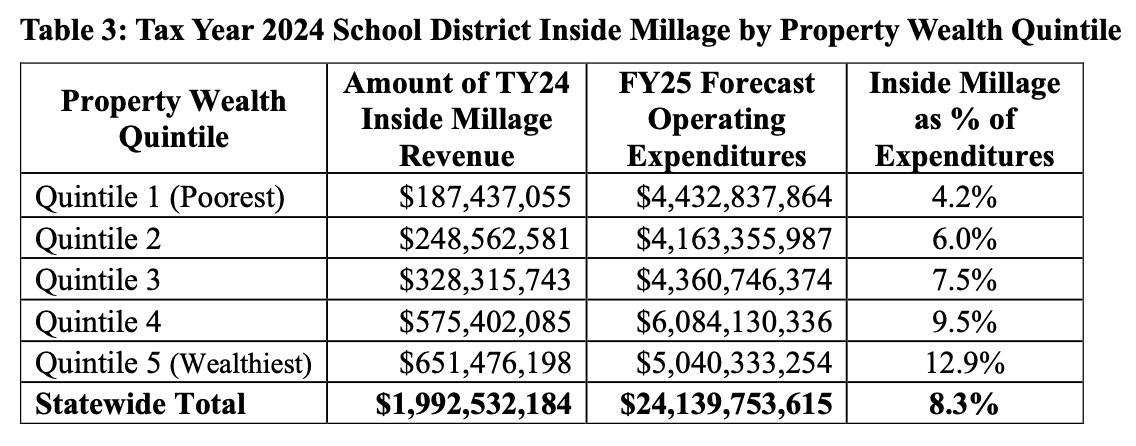
Tables 2 and 3 provide more detailed analysis of the school district share of $1.991 billion in property taxes generated by inside millage. Table 2 shows how school district inside millage is distributed across typology groups, while Table 3 shows inside millage by school district property wealth quintile.
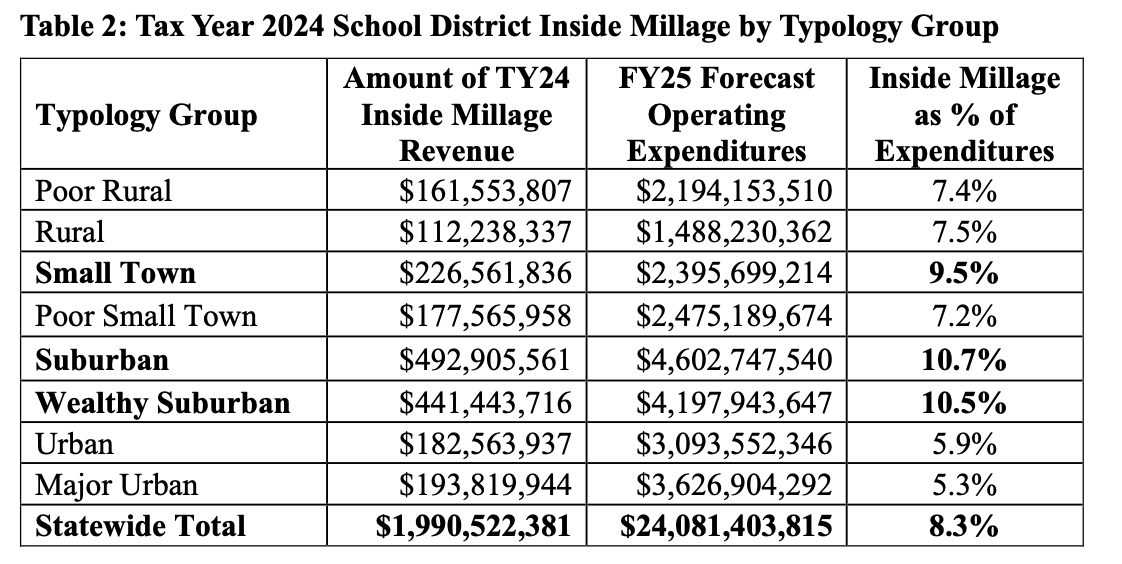
Table 2 shows that inside millage accounts for 8.3% of FY25 forecast school district operating expenditures. The inside millage share of operating expenditures is highest in suburban, wealthy suburban and small town school districts, while inside millage comprises the lowest share of expenditures in urban and major urban school districts.
Table 3 shows that inside millage contributes the smallest share of operating expenditures in Ohio’s lowest property wealth school districts and escalates as districts get more wealthy.
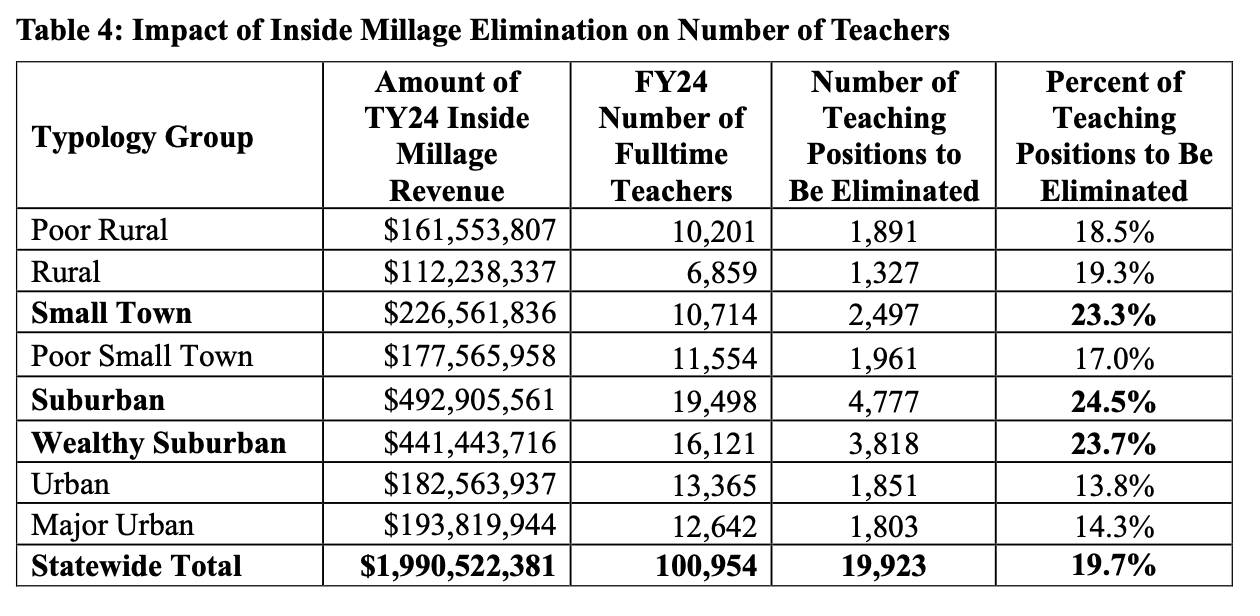
The repeal of inside millage and elimination of nearly $2 billion in school district property tax revenue will certainly have a significant impact on the ability of Ohio’s school districts to deliver educational services to the more than 1.4 million students currently enrolled in traditional K-12 districts. One of the most direct ways to demonstrate this impact is to estimate the number of teachers that would need to be cut in order to realize the reduced spending required by the loss such a significant amount of revenue. This can be done by using the average classroom teacher salary reported in the FY24 Cupp Report and adding an additional 35% for fringe benefits. The lost inside millage revenue amount in each district can then be divided by this teacher cost figure to arrive at the number of teaching positions that would need to be eliminated. The findings from this analysis by school district typology group are shown in Table 4.
Table 4 shows that statewide nearly 20,000 teachers would need to be eliminated in order to save the amount of revenue lost by the repeal of school district inside millage. This amounts to 19.7% of the current (FY24) full-time teacher force in traditional districts in Ohio. The fraction of the teacher staff that would need to be let go is highest in suburban, wealthy suburban and small town districts and lowest in urban and major urban districts. Even in the urban districts, roughly 14% of teachers would need to be let go as a result of the repeal of inside millage.
Combination of Inside Millage Repeal and the 30% Cash Balance Cap
Another major concern of HB 335 is that it proposes both the repeal of inside millage and imposes a 30% cap on allowable cash balance by school districts. The combination of these two provisions will create exceptional hardships for school districts. Losing inside millage after the imposition of the cash balance cap will immediately cause 17 districts to have a negative cash balance. An additional 65 school districts will have a cash balance under 10% and 534 school districts will have cash balances below 25% after inside millage is repealed.
Additionally, it also appears that the cash balance cap will prevent school districts from going on the November ballot to offset the impending January 2026 loss of inside millage revenue by placing a new levy before voters. Because any levy that is passed in calendar year 2026 will not provide additional revenue during calendar year 2027, Ohio’s school districts will be in dire financial circumstances during the 2026 calendar year as a result of the combined effects of the inside milage repeal and the cash balance cap.
To view a PDF version of this analysis, click here.