


February 2025
This memo provides a brief summary of OEPI’s initial analysis of the Executive Budget K-12 funding proposal. The figures in this analysis are based on LSC simulations of the Executive proposal. The main features of the Executive FY26-27 K-12 education proposal are:
- Completion of the phase-in of the new school foundation formula (Fair School Funding Plan) first enacted in FY22 to include the final 2 years of the planned 6-year phase-in.
- No updates were made to the input data used to compute the per pupil base cost in each district. This data was updated in the FY24-25 budget and is currently based on outdated data from FY22.
- The property value and income data that is used to calculate the state share of the foundation formula was updated in both FY26 and FY27.
- Reduction in transitional aid guarantee, transportation guarantee and formula transition supplement for all districts on these guarantees of 5% in FY26 and 10% in FY27. These reductions apply to each district that is on each of these guarantee provisions and are not related to whether district enrollment increases or decreases.
Table 1 provides a comparison of the impact of the Executive proposal on Ohio’s 609 traditional K-12 school districts, 49 JVSDs, 300+ community schools, and the state’s 5 school voucher programs.
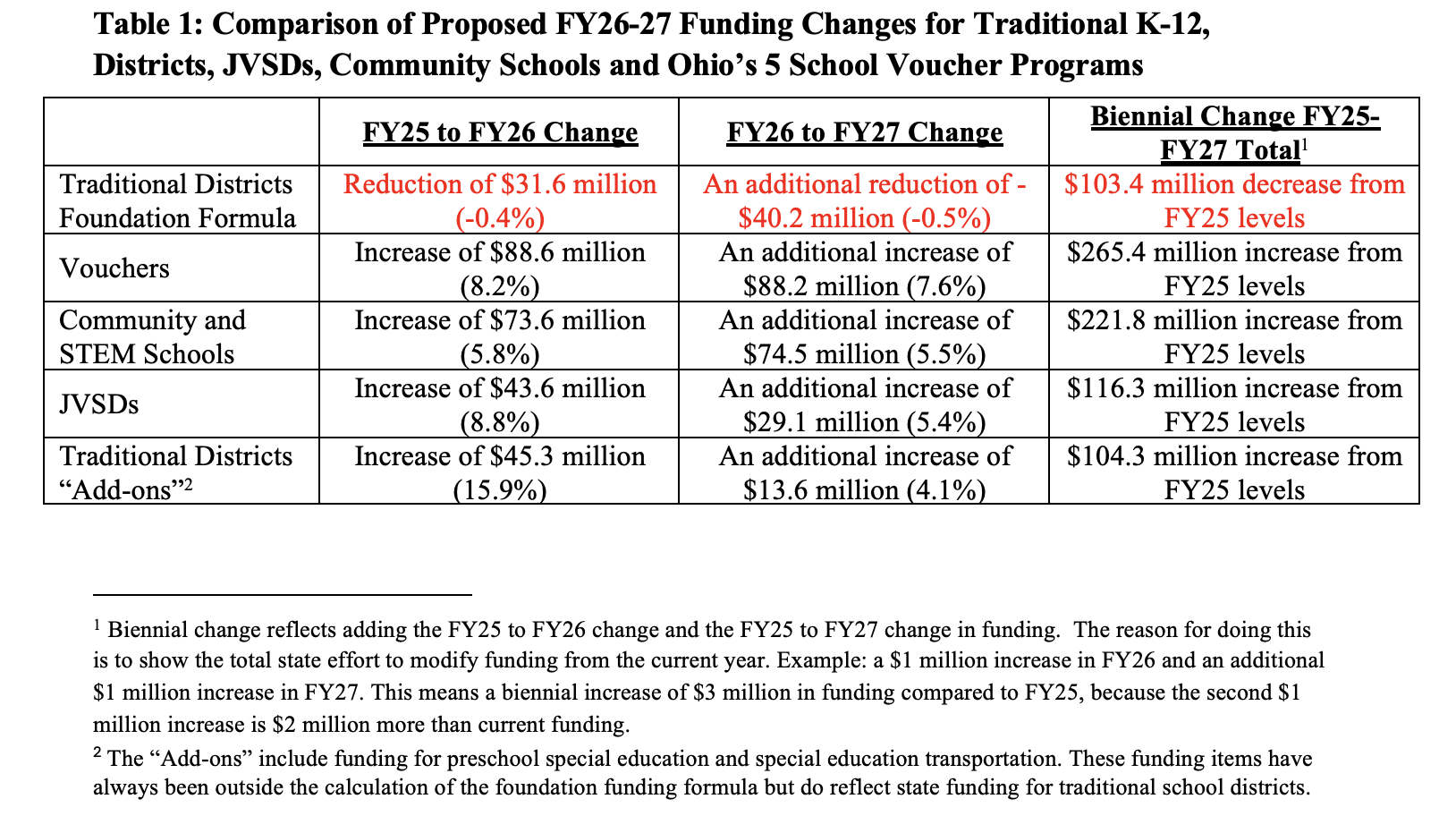
Table 1 shows that there is a $31.6 million reduction in foundation formula funding for Ohio’s traditional school districts from FY25 to FY26, and an additional decrease in formula funding of $40.2 million from FY26 to FY27. FY27 foundation formula funding for traditional districts is $71.8 million below FY25 levels ($31.6 million + $40.2 million) and thus, over the biennium, foundation formula funding for traditional school districts is $103.4 million lower than current FY25 formula funding levels.
In contrast, Table 1 also shows that funding for vouchers increases by $265.4 million over FY26-27 biennium compared to current levels, community school funding increases by $221.8 million over current levels, and JVSD funding increases by $116.3 million over current levels. These figures are all explained in more detail in sections 1-4 below.
Finally, Table 1 also shows that funding for preschool special education and special education transportation will increase by $104.3 million over the biennium compared to FY25 levels. While these funds do represent an increase in state support for traditional school districts, they have always been outside the foundation formula and have been “add-ons” to funding that school districts receive. As such, these funds are appropriately shown separately as their inclusion with formula funding would mask the impact of the Executive budget on the foundation formula itself.
- Traditional School Districts
- Foundation formula funding experiences a $31.6 million reduction (-0.4%) from FY25 to FY26 and an additional $40.2 million reduction (-0.5%) from FY26 to FY27.
- FY27 funding is $71.8 million (-0.9%) belowFY25 formula funding.
- The biennial change reflects a decrease by $103.4 millioncompared to FY25 formula funding in the FY26-FY27 biennium.
- 343 districts (56%) experience a decrease in foundation formula funding from FY25 to FY26
- 360 districts (59%) experience a decrease in foundation formula funding from FY26 to FY27
The above reductions are primarily due to the steady decline in the state share percentage in more than 80% of school districts in the FY26-27 biennium (this is discussed further in item 6 below).
The above decreases in funding are NOT due to changes in school district enrollment as the LSC simulations hold enrollment constant in FY26 and FY27 at FY25 levels.
- 68 districts (11%) gained enrollment between FY24 and FY25 but experience a net reduction in foundation formula funding compared to FY25.
- 61 (17.5%) of the 349 districts experiencing a net reduction in foundation funding in the FY26-27 biennium grew enrollment between FY24 and FY25.
- Vouchers/Scholarships
- $88.6 million increase (8.2%) in FY26 and an additional increase of $88.2 million (7.6%) in FY27.
- FY27 voucher funding is $176.8 million (16.5%) more than FY25 voucher funding.
- The biennial change in voucher funding reflects an increase of $265.4 million compared to FY25 funding in the FY26-FY27 biennium.
The increases in voucher funding are based on an estimated increase in the number of voucher students (across all 5 voucher programs) of roughly 8% per year. All voucher amounts are the same in FY26 and FY27 as in FY25 under the Executive budget.
- Community (Charter) Schools and STEM Schools
- $73.6 million increase (5.8%) in FY26 and an additional $74.5 million in (5.5%) in FY27
- FY27 community/charter and STEM school funding is $148.1 million (11.7%) more than FY25 formula funding.
- The biennial change reflects an increase of $221.8 million compared to FY25 funding in the FY26-FY27 biennium.
The community school funding increase is because community schools are 100% state funded (as they have no local property taxing authority). As a result, they benefit from increased funding from the continuation of the phase-in provisions of the Fair School Funding plan in both FY26 and FY27 but do not experience the state funding reductions caused by the ongoing decrease in state share as do the traditional school districts.
- Joint Vocational School Districts (JVSDs) and Career Technical Centers
- $43.6 million increase (8.8%) in FY26 and an additional $29.1 million increase (5.5%) in FY27.
- FY27 JVSD formula funding is $72.7 million (14.6%) more than FY25 formula funding.
- The biennial change reflects an increase of $116.3 million (23.4%) compared to FY25 formula funding in the FY26-FY27 biennium
The JVSD state/local share mechanism is a charge-off approach which does not incorporate income. This is likely the biggest reason why JVSDs fare better under the Executive budget than the traditional school districts.
- The Transitional Aid Guarantee
- In FY25, the transitional aid guarantee costs $285.1 million. 187 districts are on the guarantee this year.
- In FY26, the transitional aid guarantee increases to $408.4 million (43.2%).
- In FY27 the transitional aid guarantee increases to $564.7 million (38.3% increase vs FY26). The FY27 guarantee amount is almost exactly double the guarantee amount in FY25.
The LSC simulations clearly show that the reason that the transitional aid guarantee increases is that state share decreases and not because of a decline in student enrollment as enrollment is held constant in these simulations.
Furthermore, changes in student enrollment are not at all linked to the reductions in the guarantee. All districts that are on the transitional aid guarantee receive a 5% reduction in FY26 and a 10% reduction in FY27, regardless of past or present patterns of enrollment change.
- Change in the State Share Percentage
The current statewide average state share percentage in FY25 is 38.4%. The LSC simulations show that in FY26, the statewide average state percentage decreases to 35.0%. The LSC simulations also show that in FY27, the statewide average state percentage decreases again to 32.2%.
It is imperative to understand that the reason for the continued decline in the state share is that the property value and income data used to compute the state and local share is updated in both FY26 and FY27, while the education input data used to update the base cost figure in each school district is not updated in either year.
The Fair School Funding Plan was designed for all of the data to be updated annually so that the funding adequacy and state/local share sides of the formula work in tandem. The failure to update the input data used for the base cost calculation in parallel with the data used for the state/local share calculation has caused the decline in the state share which is the primary reason for the reductions in foundation formula funding for traditional districts seen in the Executive budget.
The base cost input data was mostly recently updated in FY24 (by using FY22 data, the most current data at the time), thus the decision to not update the inputs in FY26 or FY27 is a departure from the policy implemented in the current biennial budget.
In FY26:
- 531 of the 609 districts (87.0%) have their state share go down
- 75 districts are at the floor and their state share remains the same
- Only 3 districts have their state share increase in FY26
- 28 additional districts have their state share decrease to the 10% minimum, for a total of 103 districts at the minimum state share percentage in FY26
In FY27:
- 506 of the 609 districts (83.1%) have their state share go down
- 103 districts have their state share stay the same (the 103 districts at the minimum 10% state share in FY26)
- Zero districts have their state share increase in FY27
- Another 28 districts have their state share decrease to the 10% minimum, for a total of 131 districts at the minimum state share percentage in FY27
- General Conclusions
The Executive Budget is to be applauded for implementing the final 2 years of the phase-in of the Fair School Funding Plan.
However, there is a fundamental difference between completing the phase-in and fully funding the Fair School Funding Plan.
FY26 and FY27 will now make 3 consecutive years in which the base cost (intended to reflect the cost of educating the “typical student”) for each school district has not been updated. Additionally, because the statewide average base cost is also used for funding students with disabilities, English learners, gifted students, and career technical education students, the foundation formula proposed in the FY26-27 Executive does not provide for increases for typical students or for those with additional needs.
As result, despite the completion of the planned 6-year phase-in it cannot be plausibly claimed that the Fair School Funding plan is fully funded in FY27 because the parameters of the foundation formula are based on data that is 3 years out-of-date.
Thus, not only have the parameters used in the foundation formula in FY26 not even kept pace with inflation, but this issue is compounded by the continued decline of the state share of funding for over 80% of school districts and the reductions made to the guarantees.