


Wednesday, May 13, 2026
  1. HB 82: Report Card Changes for the 2021–22 School Year
  2. Analysis of November 2025 School Levy Results
  3. Analysis of Ohio Residential Property Taxes: A Balanced Approach to Reform
  4. Ohio Economically Disadvantaged Cost Study
  5. OEPI Analysis of Property Tax Provisions in the FY26–27 State Budget
  6. Revenue Generated by Emergency & Substitute Levies
  7. Impact of the Proposed Elimination of Inside Millage
  8. OEPI Analysis of the Impact of Eliminating Inside Millage
  9. Dr. Fleeter’s Testimony on HB 96 (Senate Education Committee)
  10. Ohio Property Tax Trends (1975-2023)
  11. State Share of Base Cost Funding FY99-FY19
  12. Dr. Fleeter’s Testimony on HB 96 (House Education Committee)
  13. Factors Behind the Transitional Aid Guarantee
  14. OEPI Analysis of Administrator Data
  15. OEPI Initial Analysis of Executive Budget K-12 Funding Proposal
  16. OEPI Analysis of Cupp Report Administrator Data
  17. OEPI Analysis of K-12 Budget Proposal
  18. OEPI Review of Ohio School Finance Study
  19. November 2024 School Levies Overview
  20. OEPI’s Ohio Special Ed Cost Analysis
  21. Ohio Property Tax Reappraisal Trends
  22. FY24 vs FY25 State Foundation Funding Comparison
  23. 2003-2023 Ohio Property Tax Reappraisal Analysis
  24. FY24 vs. FY25 School Funding Comparison
  25. Testimony on Property Tax Review and Reform
  26. Ohio School Funding Summary from FY11-FY24
  27. Dr. Fleeter on 10WBSN’s Report on Ohio Sports Gaming Revenue
  28. Dr. Fleeter’s Summary of Replacement Levy Utilization by Ohio School Districts (2014–2023)
  29. Ohio Property Tax Trends (1975–2022)
  30. OEPI HB 920: Updated Explanation
  31. Ohio School Voucher Overview
  32. Overview of Senate FY24–25 State Budget
  33. Constructing an Adequate School Funding Formula
  34. Summary of LSC HB 1 Fiscal Note
  35. House Bill 1 Summary & Analysis
  36. OEPI Economically Disadvantaged Student Cost Study
  37. Ohio Gifted Education Incentives Study
  38. Ohio Educational Service Center Cost Study
  39. Ohio English Learner Cost Study
  40. Ohio Gifted Funding Accountability Study
  41. Ohio Special Ed Cost Study
  42. New vs. Renewal Operating Levies (1994-2022)
  43. FY22 Report Card Analysis
  44. Overview of November 2022 Ohio School Levies
  45. Solar Energy Property Taxes vs. PILOT for Energy Projects (PPT)
  46. Solar Power Installation Property Taxes vs. PILOT Comparison
  47. CAUV Formula Change Analysis
  48. 2003-2022 Levies by Election
  49. New vs. Renewal and Replacement Operating Levies (1984-2022)
  50. School Operating Levies (1976-2022)
  51. School Operating & Capital Levy Totals, By Year (1984-2022)
  52. Changes in Ohio School Funding & TPP Replacement (FY11–FY22)
  53. Overview of May 2022 Ohio School Levies on the Ballot
  54. Overview of the Ohio Senate’s FY22-23 School Funding Formula
  55. The Central Importance of the DeRolph Rulings to School Funding in Ohio
  56. HB 82 Report Card System Changes
  57. Ohio Income Tax Changes and Equity (1972–2021)
  58. HB 110 EdChoice Voucher Program Changes
  59. HB 110 School Funding Formula Changes
  60. Ohio School Funding Trends (FY11–FY21)
  61. Ohio FY20 GRF Tax Revenue: COVID Impact & Recovery
  62. Ohio Solar Energy & Impact on School District Revenues
  63. House & Senate Bills Seek to Revise Ohio’s School Report Card
  64. OEPI Testimony on HB 110 School Funding
  65. Dr. Fleeter’s Testimony to the Senate Primary and Secondary Education Committee on HB 110.
  66. Updated: COVID-19 Impact on Ohio GRF Revenues (FY20 & FY21)
  67. 2020 Ohio School Levy Summary & Analysis
  68. HB 305 School Funding Plan Overview
  69. EdChoice Voucher Program Update
  70. OEPI President Message on OEPI’s Value
  71. OEPI Property Trends Report (1975-2015)
  72. Update: Appeal of Natural Gas Pipeline Values
  73. Update on Ohio’s Controversial Territory Transfer Law
  74. COVID-19 Impact on Ohio GRF Revenues (FY20 & FY21)
  75. Supplemental Funding for Power Plant Districts
  76. OEPI Officers Update
  77. Appeal of Natural Gas Pipeline Values
  78. Ohio’s Controversial Territory Transfer Law
  79. 2019 Ohio School Levy Summary & Analysis
  80. Analysis of the Cupp-Patterson School Funding Proposal (HB 305)
  81. OEPI Press Release on 20 Years of School Funding Post-DeRolph
  82. 20 Years of School Funding Post-DeRolph
  83. OEPI Analysis of Ed Trust “2018 Funding Gaps” Report
  84. OEPI Research Update: GRF Revenues, School Funding, and District Trends (2017)
  85. House Finance Primary and Secondary Ed Subcommittee House Bill 49 Testimony
  86. Analysis of HB 398 & SB 246 Changes to Ohio’s CAUV Formula
  87. OEPI Research Update: GRF Revenues, Funding Formula Issues & School Levies (2016)
  88. Community School Funding & Ohio Education Finance Trends
  89. CS Deduction and the Gain Cap
  90. Open Enrollment
  91. FY16-17 GRF Tax Revenues
  92. Casino & VLT Revenues
  93. OEPI Value Added Newsletter Article
  94. Senate Bill 208 Modifications to TPP Replacement Payments
  95. 2015 School Levy Update
  96. FY 16-17 Guarantee & Gain Cap
  97. Preliminary FY 15 Ohio Test Score Analysis
  98. Video Lottery Terminal (VLT) Revenue Update
  99. FY16-17 Phase-Out of TPP Replacement Payments
  100. FY16-17 School Funding Components
  101. Casino Tax Revenue Update
  102. Budget Bill Changes Election Law
  103. Transitional Aid Guarantee Analysis
  104. School Funding Comparison & Analysis: FY15 vs. FY17 Plans
  105. Recent Changes in Ohio Property Valuations
  106. State/Local Share of Funding in FY14-15 as Proposed by the Governor and House for FY16-17

This article provides a brief overview of school levies on the ballot in the November 8, 2022 general election. A complete list of local issues on the November 2022 ballot is included at the end of this article and can also be found on the Ohio Secretary of State’s website at: https://www.sos.state.oh.us/elections/voters/about-this-election/


Election results from prior years (which includes school levy data beginning in 2013) can be accessed from the Secretary of State website by selecting the year in question at: http://www.sos.state.oh.us/sos/elections/Research/electResultsMain.aspx

Table 1 provides a summary of the number and type of school levies on the ballot in Ohio’s general election over the last 5 years. Table 1 shows that the number of levies on the ballot has been roughly 25-30% lower the past 3 years than in 2018 and 2019. Of course, 2020, 2021 and 2022 reflect the years of the pandemic which may contribute to districts’ reluctance to ask voters for levy approval. The increase from 99 levies on the ballot in November 2021 to 121 levies on the ballot in 2022 may indicate that this reluctance is fading.


Table 1: School Levies on the November General Election Ballot 2018-2022, By Type
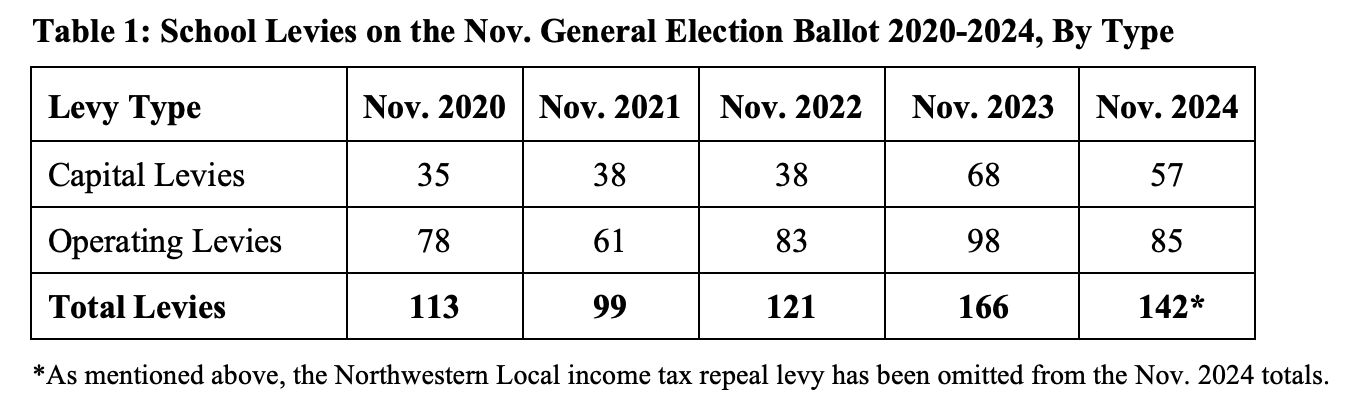
Table 2 provides a more detailed breakdown of capital levies (defined as bond levies, permanent improvement (PI) levies and combination bond/PI levies) on the ballot in Ohio’s November general election from 2018-2022. Table 2 shows that the number of capital levies on the November ballot has decreased by nearly 1/3 in 2020, 2021 and 2022 as compared to 2019, and by nearly 40% compared to 2018. The majority of capital levies are typically new levies, as bond and combination levies are always “new” since  they cannot be renewed. Capital levies historically pass 60-65% of the time in Ohio.


Table 2: Capital Levies on the November General Election Ballot 2018-2022, By Type
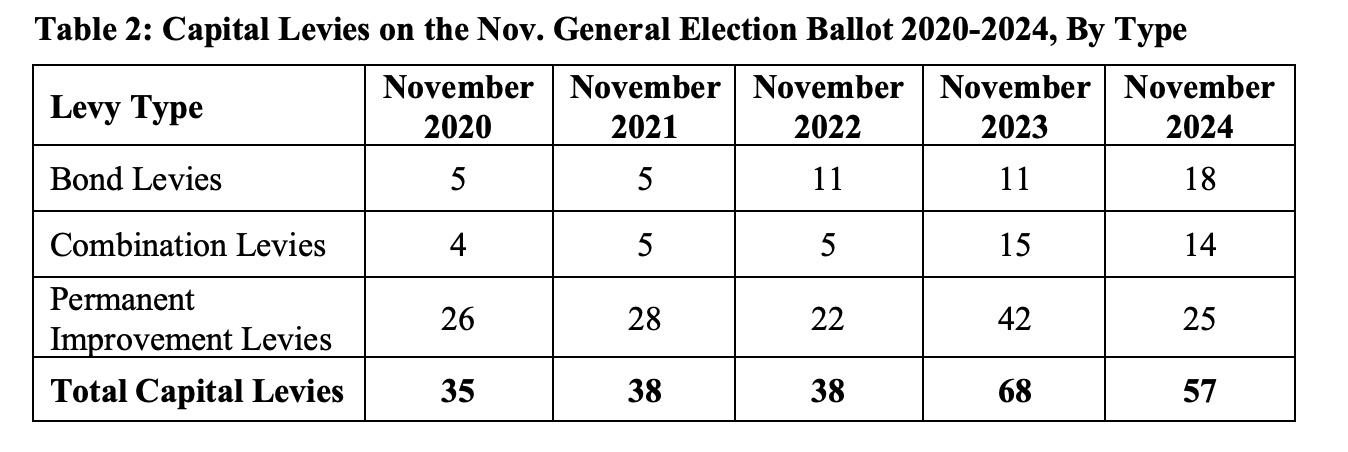
Table 3 provides a more detailed breakdown of operating levies on the November general election ballot from 2018-2022. The data in Table 3 show that over the past 5 years emergency levies typically account for roughly 1/2 of school operating levies on the November ballot in Ohio. Note that substitute levies, which allow districts to aggregate existing emergency levies, are included in the emergency levy count. Among the other types of operating levies, the number of property tax current expenses levies in 2018 and 2019 (49) was roughly the same as the number of school district income tax (SDIT) levies (55), however, there have been nearly twice as many current expense levies (72) as SDIT levies (39) on the November ballot from 2020-2022. “Other” operating levies (defined as those for county financing districts, technology levies and school safety & security levies) have comprised only a very small share of operating levies on the ballot in recent November general elections.


Table 3: Operating Levies on the November General Election Ballot 2018-2022, By Type
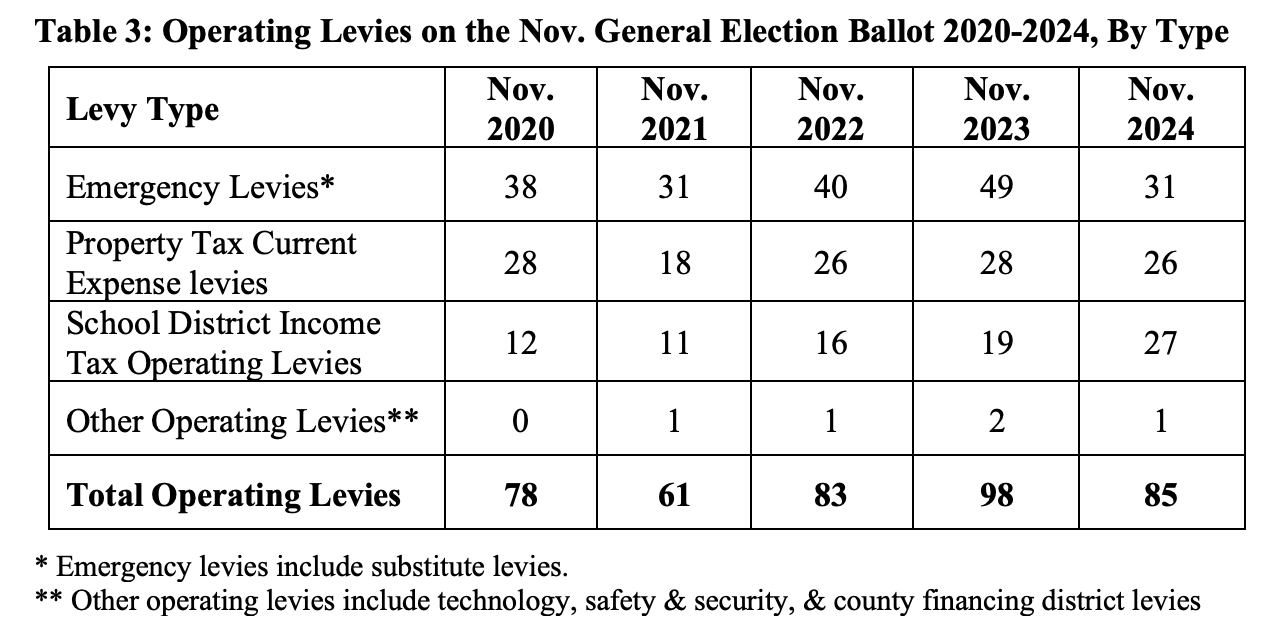
Table 4 provides additional insight on operating levies placed on the November ballot in Ohio by providing a breakdown of new levies, renewal levies, and replacement levies. New levies are defined as those that are placing new millage on the ballot, renewal levies are renewing existing term-limited levies and replacement levies (which are rarely used) restore a levy to its originally voted millage level after it has been reduced by the impact of HB 920 rolling back the voted rate. Substitute levies are considered here to be emergency renewal levies.


Table 4: Operating Levies on the November General Election Ballot 2018-2022, By Type
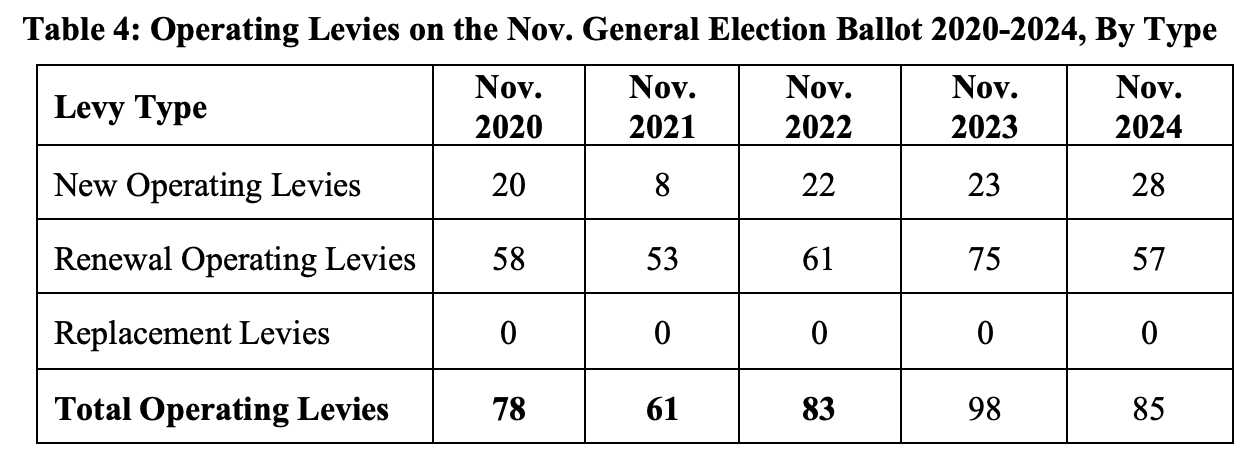
Table 4 shows that roughly 60% of operating levies on the ballot in the November general election in 2018 were renewal levies, however, the percentage of renewals increased to nearly 75% in 2019, 2020 and 2022 and was over 80% in 2021. The percentage of school levies on the ballot that have been renewals has been steadily increasing in Ohio over the past 25 years. From 1994-1997 82% of school levies were new levies. This percentage decreased to 67% from 1998-2006, to 57.5% from 2007-2013 and to only 31% from 2014-2021. While renewal levies are more successful at the ballot (renewal levies typically pass 90% of the time while new levies have passed at roughly a 40% rate in recent years), renewal levies typically do not bring in additional tax dollars whereas new levies do.


Thus, it is the expectation here that the majority of operating levies on the November 2022 ballot will pass next month because nearly three-quarters of the levies on the ballot are renewals. While this will certainly be good news in school districts that are facing expiring levies, the increase in revenue will likely be less than if the levies were new rather than renewals


Table 5 provides a complete list of school levies on Ohio’s November 8, 2022 general election ballot.


Table 5: November 8, 2022 November General Election School Levies By Type
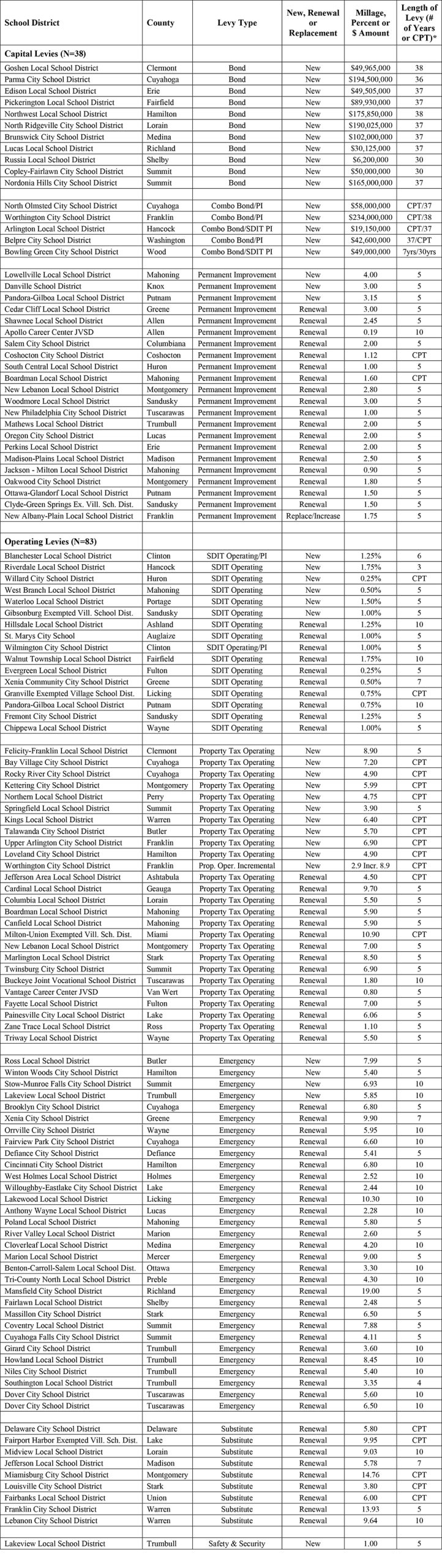
* “CPT” means Continuing Period of Time (i.e. an unexpiring levy)


Tags:

Related Article